

Genesis 11
The Tower of Babel
And the whole earth was of one language, and of one speech. (Gen. 11:1 KJV)
And it came to pass, as they journeyed from the east, that they found a plain in the land of Shinar; and they dwelt there. (Gen. 11:2 KJV)
And they said one to another, Go to, let us make brick, and burn them throughly. And they had brick for stone, and slime had they for morter. (Gen. 11:3 KJV)
And they said, Go to, let us build us a city and a tower, whose top may reach unto heaven; and let us make us a name, lest we be scattered abroad upon the face of the whole earth. (Gen. 11:4 KJV)
And the LORD came down to see the city and the tower, which the children of men builded. (Gen. 11:5 KJV)
And the LORD said, Behold, the people is one, and they have all one language; and this they begin to do: and now nothing will be restrained from them, which they have imagined to do. (Gen. 11:6 KJV)
Go to, let us go down, and there confound their language, that they may not understand one another's speech. (Gen. 11:7 KJV)
the LORD scattered them abroad from thence upon the face of all the earth:
So the LORD scattered them abroad from thence upon the face of all the earth: and they left off to build the city. (Gen. 11:8 KJV)
Therefore is the name of it called Babel; because the LORD did there confound the language of all the earth: and from thence did the LORD scatter them abroad upon the face of all the earth. (Gen. 11:9 KJV)
The construction of the tower of Babel was stopped by the LORD. He confused the Tongues.
The tower’s name was not Babel; rather, Babel was the name of the city in which the tower was built. Gen 10:10 states that Nimrod, Noah’s great-grandson through Cush, founded Babylon in in the land of Shinar (among other cities, in southern Iraq). Some translations list this city as Babel rather than Babylon, and it is widely believed that Babel and Babylon refer to the same city and the Tower was near the city of Babylon. Nimrod was the first recorded king in the Bible and the city was part of Nimrod's kingdom (Gen 10:8-10)
The construction of the tower was not simply an act of architecture, but a declaration of independence from God. Later Scripture associates Babylon with arrogance, idolatry, and hostility toward God’s people (Is 13–14; Jer 50–51; Rev 17–18). It was called Babel, because there the Lord confused [Hebrew: balal] the language.
Turris-Babel-by-Athanasius-Kircher 1602-1680
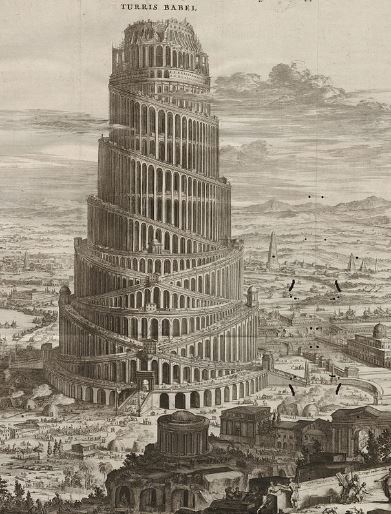
The Tower of Babel was a temple structure made of brick, approximately 300 feet (90 meters) tall, presumably dedicated to the god Marduk. Ba´al (Bel) was especially used for the Babylonian god Marduk.
Maybe you have heard of this powerful world-influencing divine being, for example
Replicas of the 28-metre Temple of Ba’al (Bel) entrance were made in New York and in Trafalgar Square in London. The Institute for Digital Archaeology originally planned to construct about 1,000 reproductions of the Palmyra Arch (weighs around 11 tons) in cities throughout the world.
Ba’al is also called the Lord of Rain and Dew with epithet as the storm god and is mentioned more than 90 times in the Bible. The name is easy to remember when you think of two chemical elements Barium (Ba) and Aluminium (Al), which are very important in the area of weather modification (alongside with Strontium-90).
QFAT (Question for advanced thinkers)
Meteorite crater don't exist, because there are no meteorite impacts. Is there a connection between the so called Meteorite crater, the ba'al weathermachine and the mudflood?
These are the generations of Shem: Shem was an hundred years old, and begat Arphaxad two years after the flood: (Gen. 11:10 KJV)
And Shem lived after he begat Arphaxad five hundred years, and begat sons and daughters. (Gen. 11:11 KJV)
And Arphaxad lived five and thirty years, and begat Salah: (Gen. 11:12 KJV)
And Arphaxad lived after he begat Salah four hundred and three years, and begat sons and daughters. (Gen. 11:13 KJV)
And Salah lived thirty years, and begat Eber: (Gen. 11:14 KJV)
And Salah lived after he begat Eber four hundred and three years, and begat sons and daughters. (Gen. 11:15 KJV)
And Eber lived four and thirty years, and begat Peleg: (Gen. 11:16 KJV)
And Eber lived after he begat Peleg four hundred and thirty years, and begat sons and daughters. (Gen. 11:17 KJV)
And Peleg lived thirty years, and begat Reu: (Gen. 11:18 KJV)
And Peleg lived after he begat Reu two hundred and nine years, and begat sons and daughters. (Gen. 11:19 KJV)
And Reu lived two and thirty years, and begat Serug: (Gen. 11:20 KJV)
And Reu lived after he begat Serug two hundred and seven years, and begat sons and daughters. (Gen. 11:21 KJV)
And Serug lived thirty years, and begat Nahor: (Gen. 11:22 KJV)
And Serug lived after he begat Nahor two hundred years, and begat sons and daughters. (Gen. 11:23 KJV)
And Nahor lived nine and twenty years, and begat Terah: (Gen. 11:24 KJV)
And Nahor lived after he begat Terah an hundred and nineteen years, and begat sons and daughters. (Gen. 11:25 KJV)
And Terah lived seventy years, and begat Abram, Nahor, and Haran. (Gen. 11:26 KJV)
Now these are the generations of Terah: Terah begat Abram, Nahor, and Haran; and Haran begat Lot. (Gen. 11:27 KJV)
And Haran died before his father Terah in the land of his nativity, in Ur of the Chaldees. (Gen. 11:28 KJV)
And Abram and Nahor took them wives: the name of Abram's wife was Sarai; and the name of Nahor's wife, Milcah, the daughter of Haran, the father of Milcah, and the father of Iscah. (Gen. 11:29 KJV)
But Sarai was barren; she had no child. (Gen. 11:30 KJV)
And Terah took Abram his son, and Lot the son of Haran his son's son, and Sarai his daughter in law, his son Abram's wife; and they went forth with them from Ur of the Chaldees, to go into the land of Canaan; and they came unto Haran, and dwelt there. (Gen. 11:31 KJV)
And the days of Terah were two hundred and five years: and Terah died in Haran. (Gen. 11:32 KJV)
This genealogy connects the story after the flood to Abraham and narrows the biblical focus from all humanity to one family through whom God's covenant will unfold.
The genealogy ends with Abram's family:
His father, Terah, his wife, Sarai, who is noted as being unable to have children at that time.
Their move from Ur toward Canaan, stopping in Haran.
11:1
11:10